

Conveyor technology at a glance: Types, applications, and the right choice
Whether belt conveyor, roller track, or transfer system, the right conveyor technology ensures products, workpieces, and components move reliably through production and automation. What conveyor systems are there, how do they differ, and which solution suits which application? This overview explains the most important options and the key selection criteria.
What is conveyor technology and how does it work?
Conveyor technology refers to technical systems that transport, feed, pass, or move goods between process steps within a company. It is a central component of industrial material flow technology, also known as material handling, and is used in particular in production, assembly, testing, and packaging.
Depending on the task, conveyor systems differ significantly in their design and operating principles. The suitable conveyor solution does not depend solely on the size and weight of the conveyed material. Equally important are the requirements for positioning accuracy, conveying speed, installation space, process environment, and degree of automation. Only the interplay of these factors can determine which system fits the process in question.
What types of conveyor systems are there?
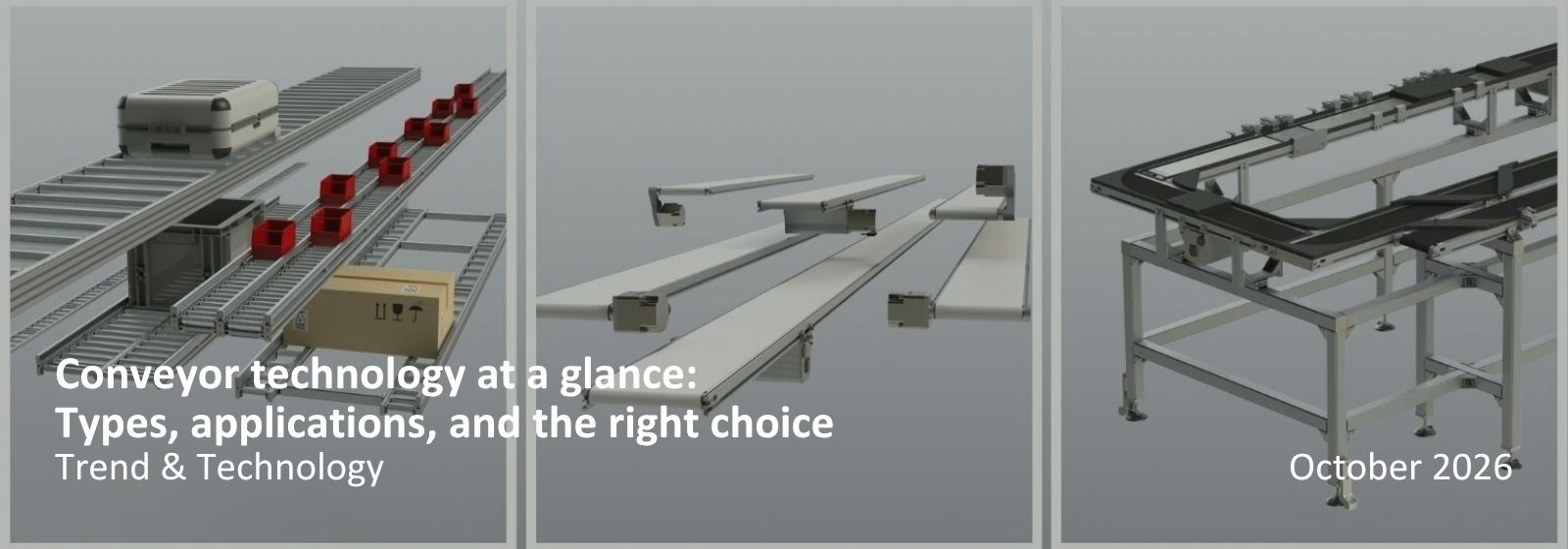
For industrial applications with general cargo, the focus is on three basic types of solutions: Belt conveyors, roller conveyors, and transfer systems. All three systems handle transport tasks but differ significantly in how they move and position material.
Belt conveyors are well suited to versatile, continuous transport tasks. Roller conveyors are a simple and robust solution for dimensionally stable goods, and transfer systems precisely transport workpiece carriers or components between a production line’s assembly, processing, and test stations.
Belt conveyors: Versatile and flexible
Belt conveyors are among the most versatile solutions in industrial conveyor technology. They automatically transport products, workpieces or components along a defined route and can be used both as an independent transport solution and as part of an automated system.
Their functional principle is comparatively simple. An endless belt conveyor runs over a drive pulley and a deflection pulley. The drive roller sets the belt in motion; the conveyed material rests on the conveyor surface and is transported at a defined speed. Depending on the application, this transport can take place continuously or in cycles.
Typical tasks for belt conveyors are the feeding of products into a processing station, transport between individual production steps or the removal of finished components. Bridging distances, linking machines, and buffering between two stations are also classic areas of application.
What advantages do belt conveyors offer?
Belt conveyors create controlled, reproducible material flow. Products move through the system on a defined path and at a uniform speed, which makes it easier to synchronize upstream and downstream work steps.
They also offer ergonomic advantages. Belt conveyors can reduce manual transport, recurring lifting, and transfers. At the same time, they enable gentle transport, which is particularly relevant for sensitive components or high quantities.
Another major advantage of belt conveyors is their configurability. Length, width, conveying speed, belt material, drive, and accessories can be adapted to the application in question. This means that the same conveyor principle can be used for very different tasks and system layouts.
Key benefits include:
- Even and reproducible material flow
- Gentle transport of sensitive products
- Good integration into production and assembly lines
- Reduced manual transport and handover processes
- Customizable dimensions and speeds
- Expandability to meet changing production requirements
- High availability in continuous operation
Montech offers various belt conveyor models for different applications, which can be adapted for design, load capacity, and application area.
TB30 belt conveyor: Flexible for different applications
Montech’s TB30 belt conveyor is designed for a wide range of industrial transport tasks. It is particularly suitable for small to medium-sized products and can be configured in different ways. Depending on the application, different belt widths, lengths, and drive concepts are available.
In addition to classic single-belt solutions, double-belt and tandem variants are also possible. This means that the TB30 belt conveyor can also be used, for example, if products must remain accessible from below or if larger, dimensionally stable workpieces are to be transported on two parallel conveyor lines.
The TB30 belt conveyor is therefore particularly suitable for applications that require a high degree of configuration freedom and flexible integration options.
TB40 belt conveyor: Compact and powerful
Montech’s TB40 belt conveyor is designed for applications that require a compact footprint and higher load capacity. With a low construction height of just 80 mm, it can be integrated into machines, production cells, or existing systems in a space-saving way.
The drive is directly integrated into the design, eliminating the need for large external motor components. This facilitates integration, especially where space is limited or a tidy system layout is required.
This means the TB40 belt conveyor is particularly effective where compact dimensions, higher loads, and space-saving integration are required.
GTB belt conveyor: For wide and voluminous conveyed goods
Montech’s GTB belt conveyor is ideal for larger, wider, or heavier products. It is designed for applications where more compact belt conveyors reach their limits due to the dimensions or weight of the material being transported.
Typical areas of application are large components, voluminous piece goods or production processes that require more space on the transport surface. The design can be adapted to the respective dimensions and load requirements.
The GTB belt conveyor thus expands Montech’s portfolio with a solution for applications that require more conveyor area and mechanical stability.
Belt conveyors for cleanroom applications
In industries such as medical technology, pharmaceuticals, electronics, and semiconductor manufacturing, cleanliness and particulate emissions must meet high standards. Conveyor technology must support controlled production processes and keep the particle load in the environment as low as possible.
Montech offers the TB30R and TB40R cleanroom belt conveyors for this purpose. Selected configurations have been tested by the Fraunhofer Institute for Production Technology and Automation IPA according to ISO 14644 and are – depending on the design and conveying speed – certified for cleanroom classes from ISO 4 to ISO 6. The belt conveyors are suitable, for example, as feed and routing belts within individual systems or for linking complete production processes.
The system also remains flexible in design: Depending on the variant, the TB30R cleanroom belt conveyor is available with a head or center drive, while the TB40R cleanroom belt conveyor features an integrated 24 V BLDC drive. Both series can be configured modularly and adapted to different requirements in terms of width, length, and process integration. The belts used are also FDA approved.
SOLTB belt conveyors: For flat and sensitive products
Flat, light, or sensitive products place special demands on transport systems. Even small bumps, awkward transfers, or unsuitable conveyor surfaces can impair the process or damage the product. Montech’s SOLTB belt conveyors are designed for these applications and are particularly suitable for products that need to be transported in a controlled, gentle manner. Depending on the area of application, this may include, for example, films, cells, or other sensitive components. They cover applications in which the focus is on particularly product-friendly conveying.
Roller conveyors: Simple, robust, and low-maintenance
Not every transport task requires a driven belt conveyor. Roller conveyors are particularly suitable for dimensionally stable goods such as cartons, containers, boxes, and workpiece carriers. The conveyed material moves over loose-bearing idler rollers and it can be transported on a slight gradient or manually, depending on the application.
Roller conveyors offer a simple solution, especially for basic transport, buffering, or transfer routes. They can be integrated into assembly areas, picking stations, and infeed and outfeed systems and they are particularly suitable for applications where a simple material flow without a motorized drive is sufficient.
What are the advantages of roller conveyors?
Roller conveyor design is simple. Since gravity roller conveyors do not require a motorized drive, construction and maintenance are manageable. At the same time, the systems are easily accessible and can be flexibly adapted to different product dimensions and layouts.
Key benefits include:
- Simple and robust construction
- Low maintenance
- No separate drive is required for gravity roller conveyors
- Flexible adjustment to width and length
- Good accessibility
- Suitable for dimensionally stable conveyed goods
- Easy integration into assembly and logistics processes
RB4020 and RB5025: Flexibly configurable roller conveyors
With its RB4020 and RB5025 roller conveyors, Montech offers solutions for different requirements and load ranges. The RB4020 roller conveyor is designed for lighter materials, while the RB5025 roller conveyor can handle larger, heavier products.
Width and length can be adjusted to the exact millimeter of the application. Depending on the conveying task, roller conveyors can be configured as single-track, double-track, multi-track or tandem versions. Side guides and matching substructures also allow adaptation to the product, process, and plant layout.
The roller conveyors are therefore suitable both for simple individual lines and for individually designed transport solutions within assembly, production, and logistics processes.
Transfer systems: Precise positioning for automated processes
Transfer systems feature a different principle than conventional belt conveyors or roller conveyors. The product is usually not moved directly on a conveying surface, but rather transported on a workpiece carrier. This keeps the component in a defined position throughout the process, making transfer systems particularly suitable for automated assembly, testing, and machining processes. Workpieces can be moved specifically from station to station and positioned there reproducibly. This allows several work steps to be combined into a clearly defined automated process.
What are the advantages of transfer systems?
The key advantage is precise, reproducible guidance of the workpieces. Since the components are fixed on workpiece carriers, their position and orientation remain defined during transport. This creates good conditions for automated machining, testing, and assembly processes.
Key benefits include:
- Precise positioning of workpieces
- Reproducible processes
- Simple linking of several process stations
- Suitable for automated assembly, testing, and machining processes
- Flexible integration into production lines
- Clearly defined transfers between stations
For different automation tasks, Montech offers two transfer systems, the LT40 and the LTE, that precisely transport workpieces and link workstations in a targeted way.
LT40 transfer system: For precise workpiece transport
Montech’s LT40 transfer system features a double-toothed belt system and transports workpiece carriers in a controlled manner between individual process stations. This means that components are guided in a defined manner during transport and can be precisely positioned at the designated stations.
The LT40 is particularly suitable for automated assembly, testing, and machining processes in which several work steps must be reliably linked. This allows workpieces to be guided through a production line and then processed, tested or assembled one after the other.
Transfer system LTE: For the step-by-step interlinking of workstations
Montech’s LTE transfer system works with a single-belt system for synchronous workpiece transport. Thanks to sequence control, the workpieces are transported step by step and guided from one workstation to the next. The system thus connects several process steps and enables a defined transfer.
This makes the LTE particularly suitable for automated production and assembly lines where successive work steps must be clearly structured and linked.
The blog post TB30 versus TB40 – two belt conveyors, a wide range of applications provides a detailed overview of the two solutions.
In which industries is conveyor technology used?
Conveyor technology is used in almost every industry where products are manufactured, assembled, tested, or processed automatically. Depending on the industry, the requirements differ – from high cycle rates to gentle transport, to precise positioning or cleanroom suitability.
In the automobile industry, assemblies and components must be transported with high availability and reproducible cycle times. Belt conveyors and transfer systems connect assembly, testing, and processing stations and support a continuous production flow.
In the electronics industry, the focus is often on sensitive components and assemblies. Here, gentle conveying, controlled product transfer, and, depending on the application, special material or ESD protection requirements play an important role.
Clean and reproducible processes are central in medical technology and the pharmaceutical industry. Depending on the process, additional cleanroom requirements apply and must be considered when selecting and designing conveyor technology.
In the packaging industry, products are continuously fed, transported, or buffered. Belt conveyors are particularly suitable for such tasks because they can be flexibly adapted to different line layouts and product formats.
Conveyor technology also plays an important role in the plastics industry, airport and security applications, and vision systems and optical testing processes. In image processing, for example, reproducible product guidance is crucial so that components can be reliably detected and tested.
Which conveyor technology is right for which application?
No single conveyor solution fits every situation. The interplay of conveyed goods, process, installation conditions, and ambient conditions is decisive. However, for initial orientation, you can classify the systems by typical requirements.
Belt conveyors are particularly suitable for continuous or cycled transport tasks and offer a great deal of flexibility in terms of dimensions, speed, and design. Roller conveyors are a robust and low-maintenance solution for dimensionally stable goods, especially when a motorized drive is not required. Transfer systems are particularly suitable when workpieces have to be precisely positioned on defined supports and moved between automated process stations.
Special requirements for product protection, cleanroom suitability, installation space, or load capacity also influence the selection. The decisive factor is therefore not which conveyor system is generally the most efficient, but which one best meets the requirements of the specific application.
Important questions for selecting the right conveyor system
The following questions can help focus the requirements for conveyed goods, process, and system environment:
- What is transported – weight, dimensions, shape, and surface?
- What environmental conditions apply: Is there a cleanroom, dust, or humidity?
- What does the transport route look like – length, width, installation height, and transfers?
- What delivery capacity and speed are required?
- Does the product need to be positioned exactly?
- Which drive solution fits the application?
- What are the safety and ergonomics requirements?
- How important are maintenance and spare parts availability?
- How flexible must the system be for subsequent adjustments?
The more clearly these points are defined, the more specifically the appropriate conveyor technology can be selected and designed.
From requirements to the right conveying solution
Once the most important requirements have been clarified, the appropriate conveyor solution can be derived. This is not only about the choice between belt conveyors, roller tracks, and transfer systems, but also about the specific design – for example, dimensions, drive, accessories, or integration into the existing system.
Montech relies on modular systems consisting of standardized components. Belt conveyors, roller conveyors, and transfer systems can thus be specifically adapted to different production and automation tasks. At the same time, subsequent extensions or changes are possible as processes or requirements change.
Montech’s online configurator allows belt and roller conveyors to be tailored directly to the application. Depending on the system, the dimensions, drive, and accessories can be configured individually. This creates a specific configuration online as a basis for further planning.
Configure the conveyor solution
For applications that go beyond a configurable standard solution, Montech also develops customized conveying solutions. The components are tailored to the application’s specific requirements, the existing system environment, and the desired process sequence. This approach enables more complex support tasks and customer-specific integrations.

Stefania Biffi
Marketing


