

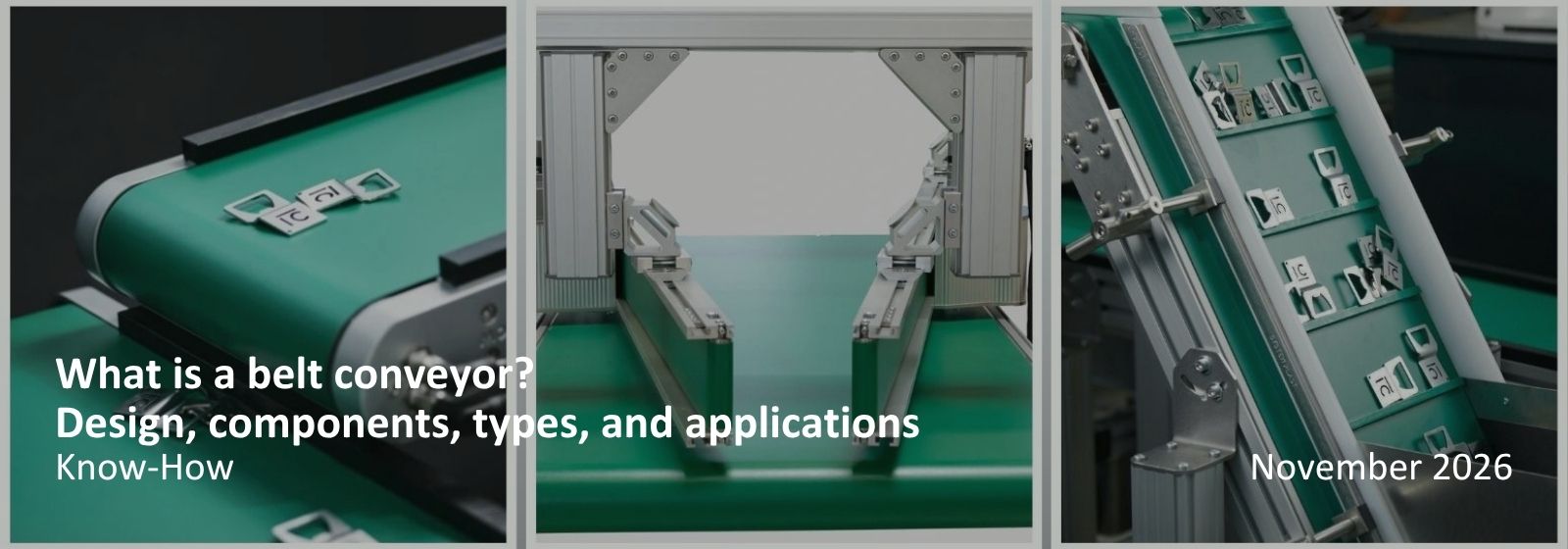
What is a belt conveyor? Design, components, types, and applications
Belt conveyors reliably transport products between process steps and are among the most versatile solutions for automated material flow. But how, exactly, does a belt conveyor work? What are its components, and which type suits which transport task? This overview explains the design, operating principle, components, and key selection criteria.
What is a belt conveyor?
A belt conveyor, also called a conveyor belt or transport belt, is a mechanical conveyor system that moves products, workpieces, or components along a defined line. It is a key component of industrial conveyor technology, especially in production, assembly, and automation. Depending on the process, it enables continuous or cycled transport between individual work steps.
Our Overview of conveyor technology describes how belt conveyors differ from other conveyor systems and what solutions are suitable for which applications.
How does a belt conveyor work?
Belt conveyors operate on an endless, closed belt loop that runs over a drive and return pulley. The drive roller transfers the movement to the belt. The conveyed goods lie on the belt surface and move with it along the conveyor line. Finally, the belt returns via the return pulley, forming a closed circuit.
Conveyor speed, direction, and type depend on the application. The length, width, belt surface, drive, and accessories also depend on the transport task. Thus, the basic principle of the belt conveyor is suitable for various products, from small and sensitive components to larger and heavier piece goods.
What are the components of a belt conveyor?
Industrial belt conveyors can vary widely in their dimensions, power, and equipment. Their basic design relies on a few central components which together ensure reliable belt running and material transport.
The most important belt conveyor components include:
- Belt: Forms the transport surface and is in direct contact with the conveyed material. The material and surface must therefore suit the product and application.
- Drive: The motor generates the necessary movement. Depending on the belt conveyor, it can be positioned differently or integrated directly into the drive roller.
- Frame or chassis: The frame supports the components of the belt conveyor and determines, among other things, stability, overall height, and integration possibilities.
- Side guides: Limit the conveying distance to the side and ensure that the conveyed goods remain on the belt.
Depending on the transport task, belt conveyors can be supplemented with components such as side guides, substructures, sensors, and other accessories. This allows the conveyor system to adapt to the product, process, and installation conditions.
What role does the belt play?
The belt is a central element of every belt conveyor because its surface is in direct contact with the material being transported. Its properties affect friction, adhesion, product protection, and how the conveyed goods behave during transport.
A smooth belt conveyor is often suitable for horizontal transport with uniform product guidance. If the material to be conveyed must be moved particularly gently, the belt surface must be adapted to the product accordingly. By contrast, structured or stud belts are used on gradients or inclines. On a stud belt, raised sections are attached to the belt conveyor at a right angle to the direction of travel. They support the conveyed material and prevent products from slipping back uncontrollably. Stud belt conveyors are therefore used primarily as ascending conveyors or if products must be transported at defined intervals.
The application environment also influences the selection. Depending on the application, you may also require cleanroom suitability, ESD properties, wear resistance, or cleanability. Therefore, always select the belt conveyor to match the material, transport route, and process.
What drive types are available for belt conveyors?
The drive determines how movement is transmitted to the belt conveyor, how conveyor speed is controlled, and how the belt conveyor can be integrated into a machine, plant, or process. In industrial conveyor technology, there are three main drive types:
- Asynchronous three-phase motor: These drives are robust, proven, and operated directly from the grid. They run at a fixed speed and are suitable for even transport tasks. A frequency converter can be used to adjust the speed if necessary.
- BLDC motor (EC motor): These drives are controlled electronically and can be controlled continuously. They are the ideal choice for changing conveying speeds and for cyclical and reversing operation.
- Motor roller: The motor is integrated directly into the drive roller. Motor rollers often run on 24V low voltage and feature a compact design with no external motor components.
Regardless of motor type, the drive position also matters. External motors can be located at the head or in the middle of the belt conveyor. A center drive keeps both belt ends free, facilitating short transfers to adjacent stations. The right drive type depends on the conveyor load, speed, operating mode, and installation space.
What types of conveyor systems are there?
With an industrial belt conveyor, you can vary more than just the belt. The arrangement of the belts can also be adapted to different transport and process requirements. There is a distinction between single-belt, double-belt, and tandem belt conveyors. The design that makes sense depends on how the product lies on the belt, how large it is, and whether it must be accessible from below during transport.
Single-belt belt conveyor: The classic design
A continuous belt forms the transport surface of the single-belt conveyor. This design is suitable for a wide range of general cargo and for typical supply, discharge, and connecting lines.
The closed contact surface ensures smooth, even transport. At the same time, belt material, width, length, and speed can be adapted to the application. Therefore, the single-belt conveyor is a flexible standard solution for many horizontal transport tasks.
Dual-belt conveyor: Access to the product from below
With a dual-belt conveyor, two parallel belts run with a free space between them. The product rests only on the two belt surfaces, while the area between them remains accessible.
This design is ideal for processes where a workpiece must be inspected, contacted, or machined from below during transport. Compared with a continuous belt, the contact surface is more precisely defined. However, the material conveyed must be sufficiently dimensionally stable to lie securely on two parallel belts.
Tandem belt conveyor: For larger dimensionally stable products
A tandem version consists of two parallel belts. It is particularly suitable for larger pallets, panels, or other dimensionally stable products that require wider support or support adapted to the product geometry.
The distance between the two conveyor sections can be adjusted to the material conveyed. This means even larger workpieces can be transported securely without needing a consistently broad belt surface.
What are belt conveyors used for?
Belt conveyors perform a variety of tasks within automated processes. You can feed products into a machine, remove them after a processing step, or connect several process stations directly. A belt conveyor can also bridge distances within a system or guide products in a controlled manner through testing, assembly, and machining areas. The specific design depends on the task in question: Single-belt conveyors are suitable for classic feed and discharge lines, double-belt versions allow access from below, and tandem conveyor belts provide support for larger, dimensionally stable products.
Typical belt conveyor tasks are:
- Feeding and discharging products
- Connecting multiple process stations
- Transporting between assembly and machining steps
- Bridging distances or height differences
- Controlled guidance through testing or inspection processes
- Transporting with access to the product from below
- Conveying larger or dimensionally stable workpieces on parallel conveyor lines
The right design depends less on a particular industry than on the belt conveyor’s specific function within the process.
What is important when integrating a belt conveyor?
In industrial applications, a belt conveyor is usually part of a machine, a production line, or an automation solution. Therefore, the belt conveyor must suit the product and be integrated appropriately into the entire process.
Key factors include available installation space, conveyor height, and transfers to upstream and downstream stations. Side guides provide controlled product guidance, while substructures create the right position and working height. Sensor technology can also be used to detect products or trigger subsequent process steps.
Transition points also deserve special attention. Especially for small, light, or sensitive products, transitions should be designed in such a way that the conveyed material can travel as smoothly as possible from one line to the next. One way to do this is with a knife edge: It replaces the traditional idler pulley and deflects the belt over a very small radius. This leaves only a minimal gap between the two belts, ensuring even small parts are transferred safely. Montech offers ball-bearing knife edges with an 8 mm diameter for the TB30 belt conveyor and a 16 mm diameter for the TB40 and GTB belt conveyors, also in cleanroom-certified designs.
A well-planned integration thus not only contributes to reliable transport, but also to stable processes throughout.
How to select the right belt conveyor
The right belt conveyor depends on the conveyed material, the transport task, and the installation conditions. The following questions help to systematically identify the most important requirements:
- What are the dimensions and weight of the material conveyed?
- What is the product’s surface?
- How long and wide must the conveyor line be?
- Is transport horizontal or is there an incline?
- What conveyor speed is required?
- Is conveying cycled or done in both directions?
- Does the product need to be accessible during transport?
- What are the requirements for belt surface and product protection?
- How should the drive be integrated into the system?
- What accessories are required for guiding, substructure, or process integration?
If these parameters are known, the belt conveyor, belt, and drive can be coordinated specifically with each other.
What belt conveyor systems does Montech offer?
Montech offers various belt conveyor solutions for different transport tasks. The systems differ in design, load capacity, dimensions, and operating environment, and can be modularly adapted to the application.
| Belt conveyor | Suitable for |
| TB30 | Flexible transport tasks with small to medium-sized products |
| TB40 | Compact design for higher load requirements |
| GTB | Wide, heavy, or voluminous goods |
| TB30R/TB40R | Applications in controlled cleanroom environments |
| SOLTB | Flat, light, and sensitive products |
The TB30 belt conveyor is particularly suitable for applications where the conveyor geometry and support must be adapted flexibly to the product and process. It is available in single-belt, dual-belt, and tandem versions, and thus can handle a wide range of transport tasks.
The TB40 belt conveyor is designed for compact installation situations and higher load requirements. With a low height of just 80 mm and an integrated drive, it is ideal for machines and systems with limited space.
The GTB belt conveyor is mainly used for wide, heavy, or voluminous goods. It complements the product line when more compact conveyors are not sufficient because of product dimensions or the required conveyor surface.
Montech offers the TB30R and TB40R cleanroom belt conveyors for controlled production environments. They are designed for applications with increased cleanliness and particulate emissions requirements.
The SOLTB belt conveyors are designed for flat, lightweight, and sensitive products. They are particularly suitable where gentle and controlled product guidance is required.
The Montech belt conveyor product line addresses a wide range of requirements for design, load capacity, product geometry, and application environment.
Configuring the appropriate belt conveyor solution
An online configurator is available for the TB30, TB40, GTB, and TB30R and TB40R cleanroom belt conveyors. This lets users adapt key parameters, such as dimensions, drive, and other components, directly to the application and configure a specific belt conveyor solution.
For applications with SOLTB conveyors, and for more complex or special requirements, Montech will help you select and design the appropriate solution. This means that you can implement a suitable belt conveyor solution even if a standard configuration won’t work.

Paula Hoffmann
Marketing


