

Energy-efficient belt conveyors: Why drive technology makes the difference
When it comes to belt conveyors, people often associate energy efficiency with the age of the equipment. However, the drive technology used is also decisive. Various drive concepts differ in design, controllability, and efficiency. Modern motors can also help to reduce energy consumption and operating costs.
In many production environments, conveyor technology is only examined more closely when faults occur or processes no longer run smoothly. As long as a belt conveyor runs reliably, it is usually considered to be in working order. From an economic point of view, however, this consideration is not always sufficient; modern requirements for energy efficiency, operating costs, and plant availability mean that the drive technology used is also becoming more of a focus. Especially in this area, technology has developed significantly in recent years.
The role of drive technology in energy efficiency
How much energy a conveyor line requires to operate depends largely on the drive technology used. The motor plays an important role in this. Mains-operated electric motors and electronically commutated motors differ, for example, in terms of efficiency, controllability, and energy consumption. Electronically commutated motors are often BLDC motors, while classic three-phase asynchronous motors can be operated directly on the line supply or via speed control. Depending on the drive concept used, the same conveying task can be carried out with different amounts of energy. Electronically commutated motors power output as needed and help reduce energy losses.
Less energy consumption, less maintenance
In addition to power consumption, maintenance is also important. Modern belt conveyors benefit from an optimized system design and – depending on the drive technology used – can work particularly energy-efficiently. Drive technology, mechanics, and control systems are specifically coordinated to make the most efficient use of energy and ensure reliable operation. On older conveyor lines, by contrast, there is frequently an increasing need for service calls, readjustments, and the replacement of individual components. This not only results in direct maintenance costs but can also lead to unplanned shutdowns. Energy-efficient belt conveyors can have twice the effect here: They reduce energy consumption and at the same time support more stable operation. Modern components, suitable dimensioning, and a design precisely for the application in question help to reduce loads and make maintenance more predictable. For companies, this means: conveyor technology should not be evaluated solely based on its function. It is also crucial how efficiently, reliably, and economically it works over its entire useful life.
Montech energy-efficient belt conveyors
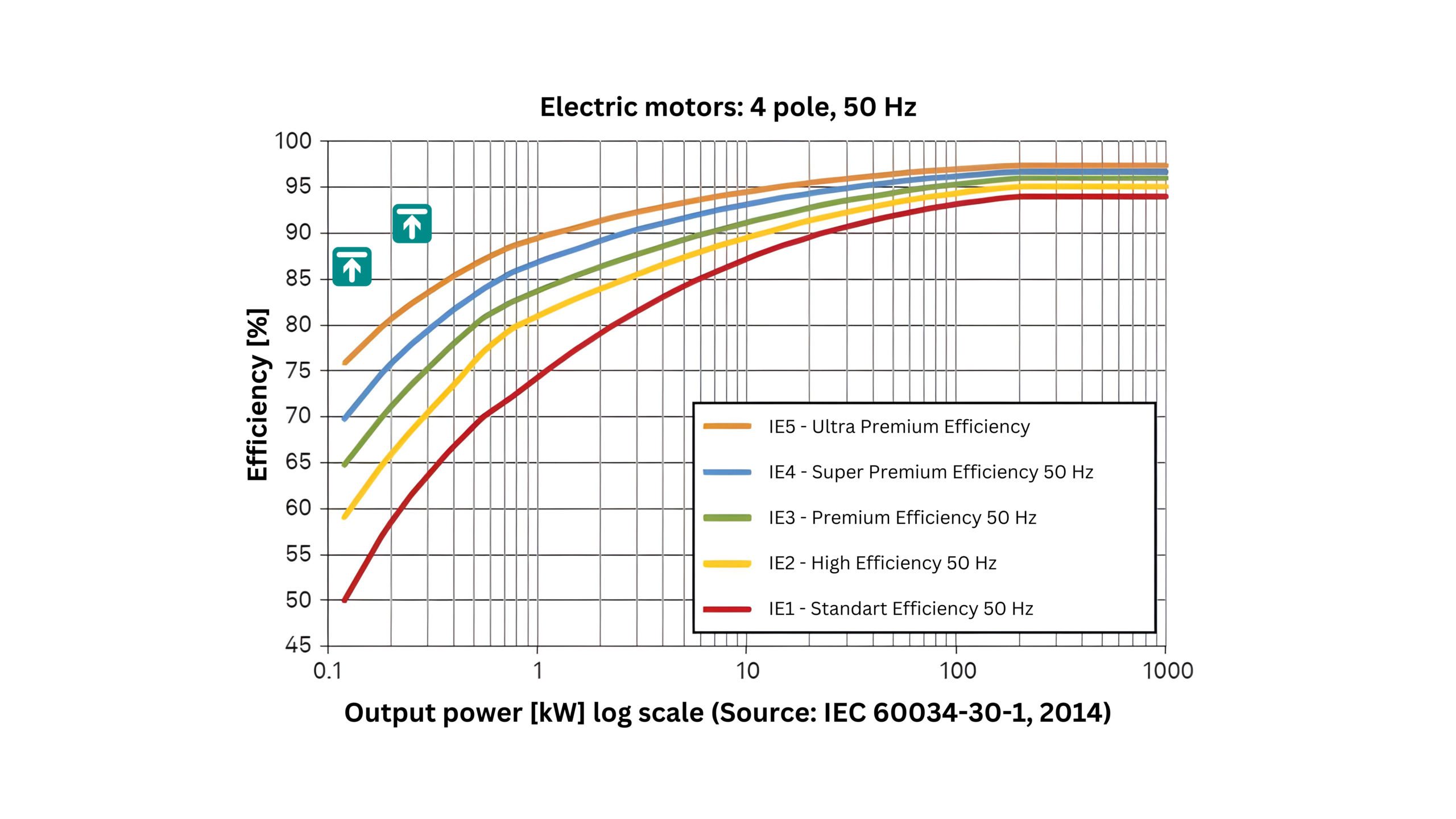
For companies that want to reduce their conveyor systems’ energy consumption, Montech offers energy-efficient belt conveyor solutions. Our TB30 and TB40 belt conveyors are designed to support conveyor processes reliably, accurately, and energy-efficiently. An important factor in this is the drive technology. Our belt conveyors are also available with electronically commutated motors. Compared to line-operated electric motors with the minimum requirement IE2, these drives can achieve up to 25% higher efficiency. In the graphical comparison shown, for IEC efficiency classes IE1 to IE5, our electronically commutated drives exceed the IE5 efficiency curve. Especially in production environments with long runtimes, this difference can be relevant. The longer a belt conveyor is in use, the greater the impact of efficiency gains over its entire operating life.
TB30 and TB40 belt conveyors for different conveying tasks
Thanks to its modular design, the TB30 belt conveyor is suitable for individual requirements in assembly technology. It can be adapted to different processes and supports a precise design of the conveyor line. The TB40 belt conveyor, on the other hand, is designed to be particularly compact. Its motor is integrated into the drive roller, allowing it to be used in confined spaces. It is powered by a 24-volt BLDC motor and can carry loads of up to 200 kilograms. Both lines thus offer different possibilities for implementing conveyor processes efficiently, reliably, and practically.
Conveyor technology: energy-efficient thinking
Belt conveyor systems are a central component of many production processes. It is precisely because they often run reliably in the background that their energy consumption is rarely critically checked. Regular checks of energy consumption, maintenance costs, and operational safety can therefore reveal potential savings. Anyone who designs conveyor technology in an energy-efficient manner or modernizes existing conveyor lines can reduce electricity and maintenance costs and improve operational safety. Energy-efficient belt conveyors are thus not only a technical component but also contribute to more economical and sustainable production.

Marina De Bastiani
Marketing


