

What is a roller conveyor? Types, applications, and the right choice
Roller conveyors transport cartons, containers, workpieces, and other dimensionally stable goods easily and reliably. But how, exactly, does a roller conveyor work? What roles do the idler roller diameter, axis spacing, and load capacity play? And which design is suitable for which application? A compact overview of the most important fundamentals and decision criteria.
What is a roller conveyor?
A roller conveyor moves material over several idler rollers arranged in a row. Roller conveyors are particularly suitable for piece goods with a stable, sufficiently flat underside, such as cartons, containers, boxes, or workpiece carriers.
Roller conveyors are used mainly in production, assembly, storage, and logistics. You can connect individual workstations; roller conveyors can serve as infeed or outfeed options, or buffer and route products within a process.
For more information on the classification of roller conveyors within industrial conveyor technology, please refer to our overview of conveyor technology.
How does a roller conveyor work?
In a roller conveyor, the conveyed material rests on several supporting rollers arranged in series. During transport, the rollers turn beneath the product, allowing it to move along the conveyor line. The material must be sufficiently supported at all times and run evenly over the rollers. In principle, gravity roller conveyors and driven roller conveyors operate on different principles and serve different applications.
What are the differences between gravity roller conveyors and driven roller conveyors?
In a gravity roller conveyor, the support rollers are freely mounted and not driven. Material moves through a slight gradient or is pushed manually. As a result, the design is simple and requires little maintenance. Gravity roller conveyors are particularly suitable for workplaces, buffer sections, and infeed and outfeed applications where no actively controlled conveyor movement is required.
In a driven roller conveyor, the rollers are driven by a motor. This allows the material to be transported automatically along the line. Such systems are particularly suitable for long conveying distances or when speed and material flow must be controlled precisely.
The right choice of variant depends especially on whether a simple passive transport is sufficient or whether the process requires an actively controlled material flow.
However, the drive type is not the only factor in the reliable operation of a roller conveyor. The dimensioning and arrangement of the support rollers must also be suitable for the material being transported.
How do the roller diameter and axis distance affect the roller conveyor?
Roller diameter and axis distance are important parameters in roller conveyor design. The idler roller diameter is the diameter of each roller. The axis distance is the distance between the centers of two successive support rollers.
Both parameters must be adapted to the dimensions, weight, and nature of the material being transported. Among other things, the idler roller diameter affects load capacity and roller conveyor size. Idler rollers should match the material conveyed and the required load capacity.
The axis distance is also selected to match the material being transported, ensuring adequate support during transport. Smaller or shorter products usually require a narrower roller distribution, whereas larger distances may be possible for larger and dimensionally stable conveyed goods.
Which loads can roller conveyors transport?
The possible load on a roller conveyor cannot be determined solely by the total weight of the material conveyed. It is also crucial how this weight is distributed among the individual carrier rollers.
Roller diameter, roller length, axle spacing, and the number of rollers loaded simultaneously also matter. If a product is placed on many carrier rollers, the load is distributed differently than on a short material carried by only a few rollers.
The product’s width and shape also influence the design. For example, large or heavy goods can benefit from several parallel roller lines because they distribute the load across additional rollers and provide more robust product guidance.
When selecting a roller conveyor, don’t consider only the weight of the material being conveyed. Equally important are its dimensions, the contact surface, and the desired roller conveyor design.
What types of roller conveyors are there?
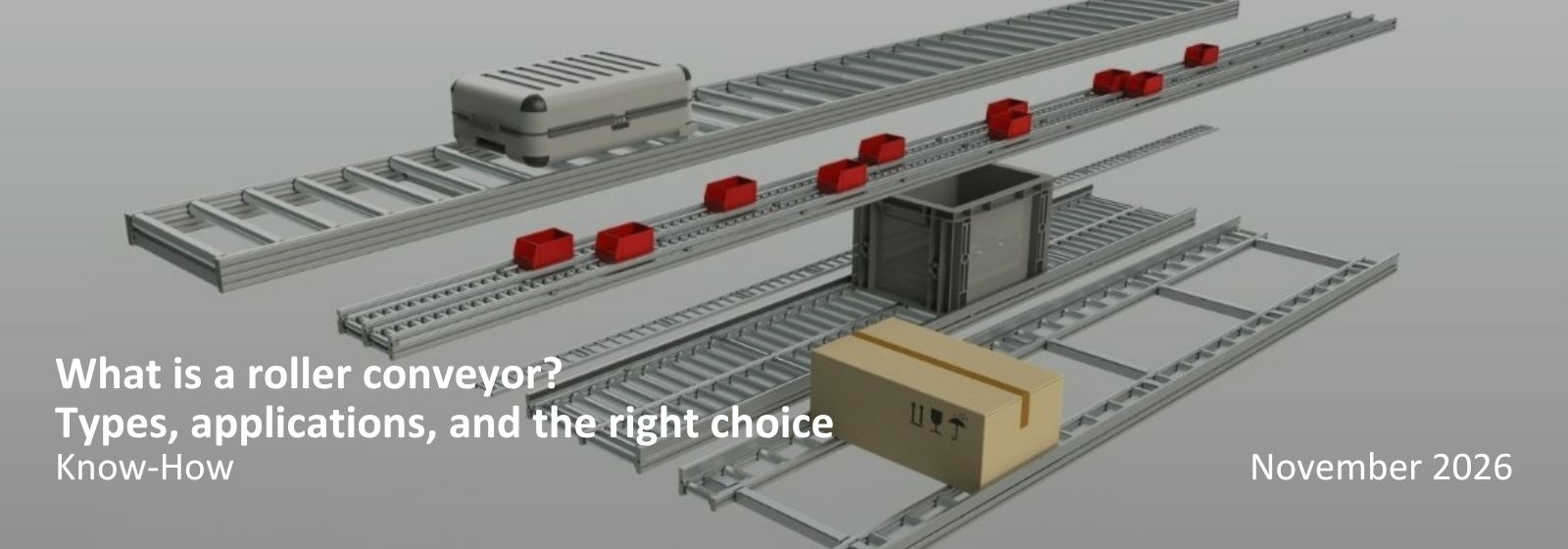
Roller conveyors can be single-track, double-track, tandem, or multi-track. The right design depends on the size, weight, and geometry of the material being transported, as well as the specific transport task.
Single-track roller conveyor: The classic design
In a single-track roller conveyor, the material travels on a continuous roller conveyor. This design is suitable for classic transport tasks involving cartons, containers, workpiece carriers, or other dimensionally stable piece goods.
Conveyor width, line length, and roller spacing are tailored to the product. Single-track roller conveyors are therefore a versatile solution for many standard applications.
Double-track roller conveyor: Additional stability
A double-track roller conveyor consists of two parallel roller lines. As a result, it provides more carrier rollers, and the weight of the conveyed material can be distributed across two lanes. This design is especially suitable for heavier or larger products when a single-track roller conveyor cannot provide sufficient stability or load capacity.
Tandem roller conveyor: For wide and bulky products
In a tandem roller conveyor, two roller lines run parallel to each other at a greater distance. This supports wide products in two defined areas while leaving the space between the lanes free. This configuration is useful for large plates, containers, or other bulky goods. At the same time, the free area allows access to the product from below.
Multi-track roller conveyor: Flexible for special requirements
Multi-track roller conveyors combine several individual roller lines. This allows products to be supported at multiple defined points or multiple conveyor lines to be guided in parallel. This design offers great flexibility for more complex product geometries or applications that require different track widths and roller spacing.
What are roller conveyors used for?
Roller conveyors are particularly suitable for transporting dimensionally stable general cargo along defined lines. Their simple design makes them well suited to tasks that don’t require complex product management.
Typical applications are:
- Feeding and removal of cartons, containers, or workpiece carriers
- Transport between assembly stations and workstations
- Buffer lines within production processes
- Picking and shipping areas
- Receiving and outgoing goods
- Transfers between individual process steps
- Transport of large or bulky products on multiple lanes
The underside of the conveyed material is a key factor when considering a roller conveyor. Freely rotating rollers generally transport uneven, very soft, or unstable products less reliably than goods with a flat, dimensionally stable contact surface.
What’s important when integrating a roller conveyor?
A roller conveyor is usually part of a larger work- or material-flow system. That’s why the rollers and conveyor width must be suitable for the product and for integration into the existing environment.
Important factors include working height, belt length, transfer points, and available space. Side guides keep the material on the track, while a suitable substructure raises the roller conveyor to the required height.
Transfers to machines, belt conveyors, or other roller conveyors should also be considered during planning. The better the height, alignment, and roller spacing at the transfer points match, the more evenly the material can be moved from one station to the next.
How to select the right roller conveyor
The starting point is always the material to be conveyed. Length, width, weight, and underside determine which rollers, which conveyor width, and which axis distance make sense.
The following questions will help guide you:
- What are the dimensions of the conveyed material?
- How heavy is the product?
- Is the underside stable and sufficiently level?
- How many support rollers should support the product at the same time?
- What axis distance is required for this?
- Is a single-track roller conveyor sufficient?
- Is a multi-track design required for heavy or large products?
- What belt length and working height are required?
- Are side guides, substructures, or other additions necessary?
The more specific these parameters are, the better the design, roller diameter, and axis distance can be adapted to the transport task.
What roller conveyors does Montech offer?
Montech’s RB4020 and RB5025 roller conveyors are designed for different requirements and load ranges. Conveyor width, axis distance, and line length can be adapted to the material being conveyed. Single-track, double-track, tandem, and multi-track versions are also available.
| Montech roller conveyor | Suitable for |
| RB4020 single-track roller conveyor | Smaller and lighter conveyed goods |
| RB5025 single-track roller conveyor | Larger and heavier goods |
| RB4020 double-track roller conveyor | Lighter goods with a greater need for stability and load distribution |
| RB5025 double-track roller conveyor | Larger and heavier goods with a greater need for stability and load distribution |
| RB4020 multi-track roller conveyor | Multiple material lines or special product geometries for lighter materials |
| RB5025 multi-track roller conveyor | Multiple conveyor lines or special product geometries for larger and heavier goods |
| RB5025 tandem roller conveyor | Wide or bulky goods |
The RB4020 roller conveyor features support rollers with a 20 mm diameter. Depending on the design, axis distances range from 31 to 132 mm; load capacity is up to 9 kg per roller and decreases with longer roller lengths.
The RB5025 roller conveyor has 50 mm diameter support rollers and is designed for larger and heavier conveyed goods. The rollers can handle up to 20 kg per roller; the axis distance can be selected between 62 and 200 mm, depending on the design.
Double-track versions are available for heavy or large-volume goods. The tandem version of the RB5025 roller conveyor enables conveyor widths up to 2025 mm and is therefore also suitable for particularly wide or bulky products.
Multi-track systems can be planned individually with regard to belt widths, roller spacing, and belt lengths.
In addition, Montech roller conveyors can be combined with side guides and substructures, among other things. This lets you adapt them to the product, working height, and plant layout.
The right roller track solution for your application
With the RB4020 and RB5025 roller conveyors, Montech offers a variety of solutions for different cargo types and load capacities. Montech’s online configurator makes it easy to choose the right version for your application.
After you enter the dimensions and weight of the conveyed material, the system identifies the relevant requirements and automatically suggests a suitable roller conveyor model. It can then be further adapted to suit the specific application.
Configuring the roller conveyor
For special product dimensions or more complex requirements, Montech will also be happy to assist you in selecting and designing the appropriate roller conveyor solution.

Paula Hoffmann
Marketing


