

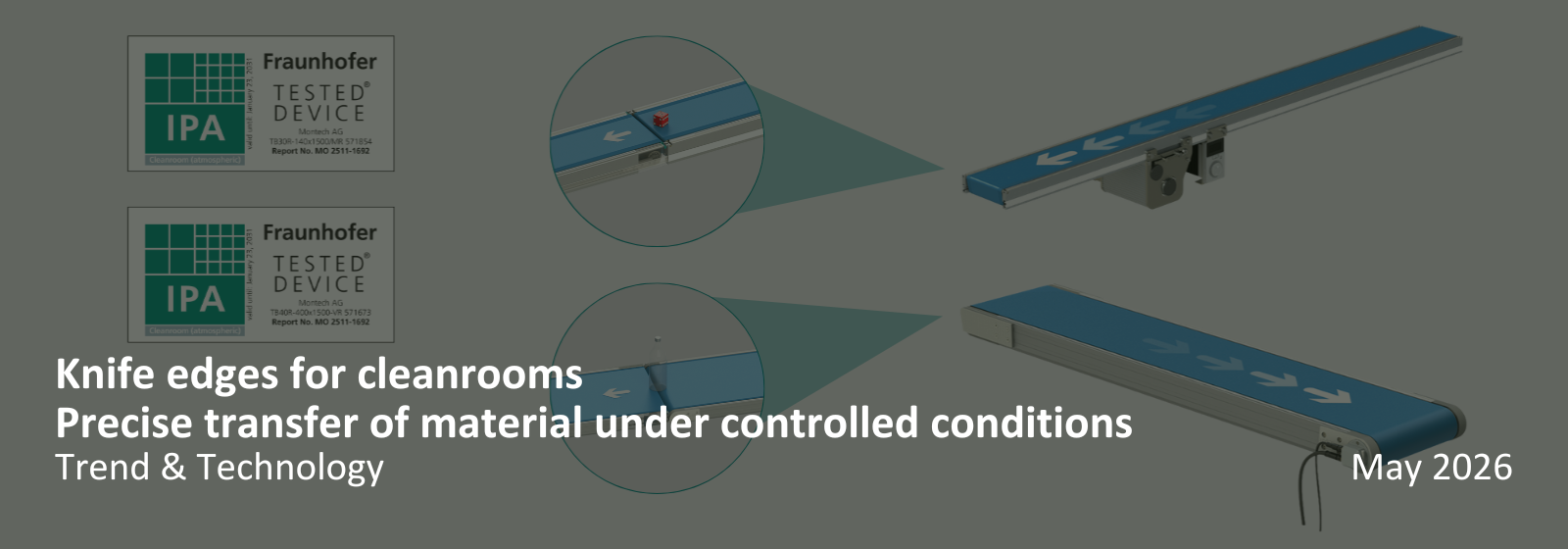
Knife edges for cleanrooms: Precise transfer of material under controlled conditions
Knife edges ensure precise and reliable transfers on belt conveyors – especially for small or sensitive conveyed goods. However, additional requirements apply in cleanroom environments. Certified solutions ensure compliance with both process stability and defined air purity classes.
A stable material flow is crucial for efficiency and process reliability in automated production processes. Transfer points between individual conveyor lines are particularly critical. Even the smallest gaps can cause goods to get stuck, shift, or stall processes. Knife edges offer a constructive solution for this by minimizing the transfer area between two conveyor lines.
What are knife edges – and when are they used?
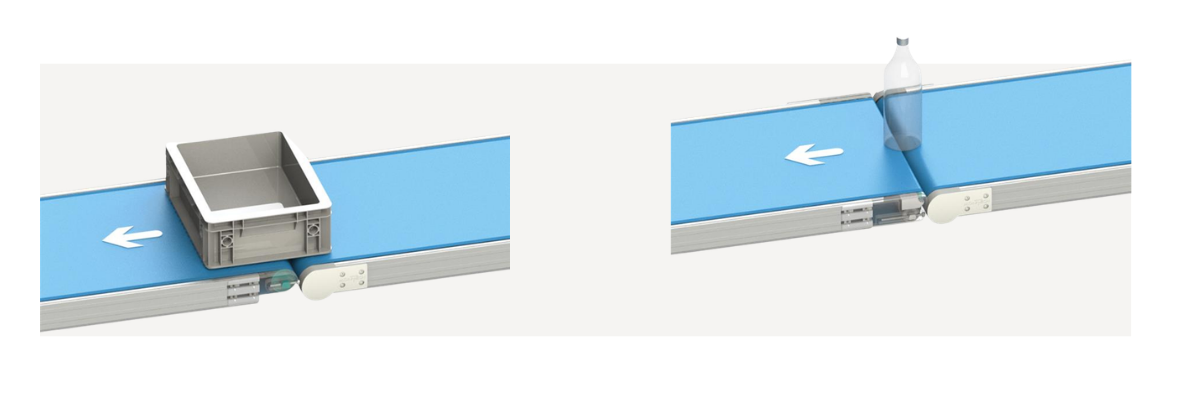
Knife edges are specially designed deflectors with a very small diameter. They enable the transfer of conveyed goods from one conveyor line to the next almost gap-free. They are used wherever precise transfers are crucial – for example, in case of small, light or sensitive components. Typical applications include assembly automation, electronics manufacturing, medical technology, and handling of small parts.
Why are knife edges so important in conveyor technology?
The central advantage of knife edges is their geometry. The small deflection diameter minimizes the transfer area between two conveyor lines, significantly reducing intermediate gaps and increasing process reliability: Conveyed goods are transported reliably without getting stuck or changing position. At the same time, this reduces the risk of disruptions and production interruptions. Knife edges also have a positive effect on operation. Lower friction reduces energy consumption, minimizes heating, and can extend the life of the belt conveyor.
What special requirements apply in cleanrooms?
In cleanroom environments, the focus is on particle emissions and process stability. Conveyor components must be designed in such a way that they do not compromise the defined air purity class. This means that knife edges must also prove that they do not release any impermissible particles under real operating conditions. The right design is not sufficient – tested and certified solutions are required.
How was the Montech cleanroom knife edge certified?
Montech has had its knife edge certified for use in cleanroom applications. The test was carried out by the Fraunhofer Institute for Production Technology and Automation IPA under cleanroom conditions according to ISO 14644-14. The certification confirms that the knife edge meets the particulate emissions requirements for use in cleanrooms up to air purity class ISO 5.
The following models were tested with the knife edge and received the TESTED DEVICE® certificate:
TB30 center drive:
- TB30R-140×1500/MR 571854 at 15 m/min.
- TB30R-140×1500/MR 571854 at 30 m/min.
TB40:
- TB40R-100×1500-VR 571673 at 15 m/min.
- TB40R-100×1500-VR 571673 at 30 m/min.
What are the advantages of the TESTED DEVICE® certificate?
For companies in regulated industries such as medical technology, pharmaceuticals, and electronics manufacturing, the TESTED DEVICE® certificate guarantees significantly greater planning security. You can rely on a tested product that meets both functional and regulatory requirements. At the same time, all the advantages of the knife edge are retained: Minimal transfer areas, stable processes, and efficient operation.
How can knife edges be integrated flexibly into existing systems?
The knife edge is an accessory in Montech’s modular belt conveyor systems and it can be integrated seamlessly into existing configurations. The online cleanroom configurator can be used to design it directly according to the customer’s requirements. This allows the system to be used in cleanrooms without any essential adjustments.

Stefania Biffi
Marketing


